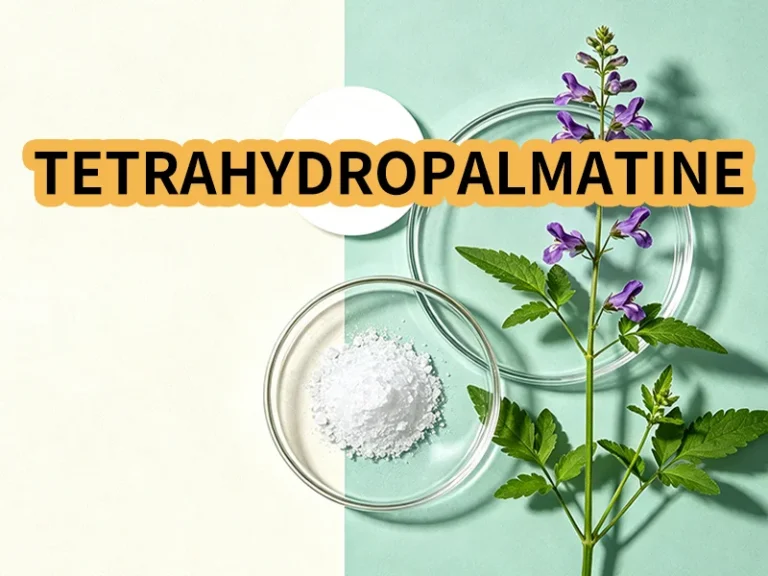
What Is Tetrahydropalmatine 98%?
Tetrahydropalmatine (THP) is a naturally occurring isoquinoline alkaloid found in several medicinal plants, particularly species of the Corydalis genus. It has been investigated extensively for its chemical characteristics, pharmacological mechanisms, pharmacokinetics, and safety profile.
Tetrahydropalmatine 98% refers to a high-purity ingredient with an assay specification of approximately 98%. For B2B buyers, this grade is generally positioned as a standardized botanical-derived ingredient for research, formulation development, analytical testing, and natural-product ingredient applications.
Scientific literature describes tetrahydropalmatine as a tetrahydroprotoberberine-type isoquinoline alkaloid. Corydalis yanhusuo is one of the important botanical sources studied for THP and related alkaloids.
Importantly, the term “98%” describes purity or assay specification, rather than a claim about biological efficacy. The exact stereochemical composition should also be confirmed from the product specification and analytical documentation when purchasing a high-purity THP ingredient.
Botanical Sources of Tetrahydropalmatine
Tetrahydropalmatine has been identified in several plants containing tetrahydroprotoberberine alkaloids. Research literature has particularly examined Corydalis yanhusuo, a traditional botanical source of alkaloid-rich extracts.
Studies of Corydalis yanhusuo have identified multiple alkaloid constituents, including tetrahydropalmatine and related compounds. The alkaloid profile can vary depending on botanical origin, cultivation conditions, processing methods, extraction procedures, and analytical methods.
For commercial ingredient sourcing, botanical identification and raw-material traceability are therefore important factors when evaluating a tetrahydropalmatine supplier.
Key Characteristics of Tetrahydropalmatine 98%
For B2B applications, a high-purity tetrahydropalmatine ingredient can be evaluated from several technical perspectives.
1. High Assay Specification
A 98% specification indicates a concentrated ingredient intended for applications where relatively high chemical purity and controlled composition are required.
For procurement, buyers should confirm:
- Assay value
- Analytical method
- Chromatographic purity
- Related substances
- Residual solvents
- Moisture or loss on drying
- Heavy metals
- Microbiological parameters, where applicable
The exact testing requirements should be aligned with the intended application and destination-market regulations.
2. Defined Chemical Identity
Tetrahydropalmatine belongs to the tetrahydroprotoberberine family of isoquinoline alkaloids.
Because stereochemistry can be relevant to the identity and properties of THP-related materials, buyers should not rely solely on the general product name. The specification should clearly indicate the chemical identity and, where relevant, stereochemical information.
3. Botanical Traceability
When THP is produced from botanical raw materials, traceability can provide useful information about:
- Botanical species
- Plant part
- Geographic origin
- Raw-material processing
- Extraction batch
- Purification batch
- Final product batch
This information is particularly useful for B2B customers developing standardized botanical ingredients.
Research on Tetrahydropalmatine
- Tetrahydropalmatine has been investigated in pharmacological research involving several biological pathways.
- Published reviews discuss research related to the nervous system, pain-associated mechanisms, neurotransmitter systems, pharmacokinetics, and toxicological characteristics. However, much of the available evidence comes from laboratory and animal studies. These findings should not automatically be interpreted as demonstrated clinical effects in humans.
- Research on Corydalis yanhusuo has also focused on its broader alkaloid profile rather than tetrahydropalmatine alone. This distinction is important because botanical extracts contain multiple compounds, while a 98% THP ingredient represents a much more defined chemical material.
Tetrahydropalmatine 98% Production and Purification
A high-purity botanical alkaloid generally requires several processing and quality-control stages.
A typical manufacturing workflow may include:
Raw Material Selection → Botanical Identification → Pretreatment → Extraction → Separation → Concentration → Purification → Drying → Quality Testing → Packaging
Raw Material Selection
The process begins with properly identified botanical raw materials. Species authentication and raw-material quality are important because alkaloid composition can vary between plant materials.
Extraction
Selected raw materials undergo extraction using an appropriate process designed to recover the target alkaloid fraction.
Separation and Purification
After extraction, separation and purification steps are used to enrich tetrahydropalmatine and remove unwanted matrix components and other constituents.
For a 98% specification, purification and process control become particularly important because the final product requires a substantially higher level of compositional consistency than a conventional crude botanical extract.
Drying and Final Processing
After purification, the concentrated material can be processed into a stable powder or other specified form according to the product specification.
Quality Testing
Each batch should be evaluated using an appropriate analytical method, typically supported by chromatographic analysis such as HPLC.
A professional B2B supplier should be able to provide batch-specific documentation rather than relying only on a generic product specification.
Quality Control for Tetrahydropalmatine 98%
For procurement teams, the most important question is not simply whether a product is labeled “98%,” but whether the specification can be independently supported by analytical documentation.
A practical quality-control package may include:
- Identity: confirmation of the target compound
- Assay: quantitative determination of tetrahydropalmatine
- HPLC chromatogram: evaluation of chromatographic profile
- Related substances: control of other chemical constituents
- Residual solvents: according to the manufacturing process
- Heavy metals: according to applicable requirements
- Microbiological testing: where relevant
- Moisture: according to specification
- Batch number: traceability from raw material to finished product
- COA: batch-specific Certificate of Analysis
- TDS: Technical Data Sheet
- SDS: Safety Data Sheet
For international B2B procurement, these documents can help buyers evaluate whether a material is suitable for their internal quality system and downstream formulation requirements.
Applications of Tetrahydropalmatine 98%
Because high-purity THP provides a more defined chemical composition than a conventional botanical extract, it can be considered for several B2B applications.
Botanical Ingredient Research
Tetrahydropalmatine can be used as a defined reference ingredient in botanical research and natural-product investigations.
Pharmaceutical and Pharmacological Research
THP has been studied extensively in pharmacological research, including investigations into nervous-system-related mechanisms, analgesic mechanisms, pharmacokinetics, and toxicology.
Analytical Research
High-purity THP can be used as an analytical reference or research material for the identification and quantification of related alkaloids.
Botanical Extract Development
For companies developing standardized botanical extracts, a defined THP material can be relevant to analytical method development, quality evaluation, and research into alkaloid composition.
The suitability of the ingredient for food, dietary supplement, cosmetic, pharmaceutical, or other commercial applications depends on the regulatory requirements of the specific market and intended use.
What Should Buyers Check When Purchasing Tetrahydropalmatine 98%?
1. Confirm the Chemical Identity
Make sure the supplier clearly identifies tetrahydropalmatine and provides appropriate analytical evidence.
If stereochemistry is important for your application, request specific information about the stereochemical form rather than assuming that “tetrahydropalmatine 98%” refers to a particular stereoisomer.
2. Request a Batch-Specific COA
A COA should correspond to the actual production batch rather than being a generic document.
Check the reported assay, testing method, batch number, manufacturing date, and specification limits.
3. Review the HPLC Data
For a 98% product, chromatographic data are particularly useful for evaluating purity and consistency.
Buyers can request an HPLC chromatogram together with the analytical method and specification.
4. Evaluate Batch-to-Batch Consistency
A reliable supplier should be able to maintain relatively consistent specifications between production batches and provide traceability documentation.
5. Check Documentation for Your Market
Depending on the application and destination market, buyers may require:
- COA
- TDS
- SDS
- HPLC report
- Heavy metal report
- Microbiological report
- Residual solvent report
- Pesticide residue testing, where applicable
- GMO statement
- Allergen statement
- Origin statement
- Regulatory documentation
The exact document package should be confirmed before placing a commercial order.
Tetrahydropalmatine 98% for B2B Ingredient Development
For ingredient companies, formulators, laboratories, and research organizations, a high-purity tetrahydropalmatine material is generally evaluated from three perspectives: chemical specification, analytical evidence, and supply consistency.
Rather than selecting a supplier only according to the stated assay, procurement teams can evaluate the complete quality system behind the product.
A suitable supplier should be able to explain the botanical source, manufacturing process, purification approach, testing methodology, packaging conditions, and batch-traceability system.
For international B2B cooperation, clear technical documentation and responsive communication are also important because the same ingredient may be evaluated by R&D, purchasing, quality-control, and regulatory teams before commercial approval.
Frequently Asked Questions
Q1:What is Tetrahydropalmatine?
A:Tetrahydropalmatine (THP) is a naturally occurring tetrahydroprotoberberine-type isoquinoline alkaloid found in several plants, including Corydalis species.
Q2:What does Tetrahydropalmatine 98% mean?
A: It generally indicates a high-purity material with an assay specification of approximately 98%. The exact analytical definition should be confirmed through the supplier’s specification and COA.
Q3:Is Tetrahydropalmatine the same as Corydalis extract?
A: No. Corydalis extract is a botanical mixture containing multiple constituents, while tetrahydropalmatine 98% is a high-purity defined ingredient.
Q4: What testing method is commonly used for THP purity?
A: Chromatographic methods such as HPLC are commonly used for quantitative analysis and purity evaluation. The specific analytical method should be stated in the product specification.
Q5: Should buyers request information about stereochemistry?
A: Yes. If stereochemical identity matters for the intended application, buyers should request the supplier’s specific stereochemical information rather than assuming that the general term “tetrahydropalmatine” identifies a single stereoisomer.
Q6: What documents should be requested before purchasing?
A:For B2B procurement, buyers can request a batch-specific COA, TDS, SDS, HPLC data, and relevant contaminant-testing reports. Additional documentation should be determined according to the intended application and destination market.
References
- A Comprehensive Review on the Chemical Properties, Plant Sources, Pharmacological Activities, Pharmacokinetic and Toxicological Characteristics of Tetrahydropalmatine. Frontiers in Pharmacology, 2022.
- The Analgesic Properties of Corydalis yanhusuo. Molecules, 2021, 26(24): 7498. DOI: 10.3390/molecules26247498.
- The composition, pharmacological effects, related mechanisms and drug delivery of alkaloids from Corydalis yanhusuo. Biomedicine & Pharmacotherapy, 2023, 168: 115511. DOI: 10.1016/j.biopha.2023.115511.
- A Review of the Traditional Uses, Botany, Phytochemistry, Pharmacology, Pharmacokinetics, and Toxicology of Corydalis yanhusuo. 2020.
- Processing and Compatibility of Corydalis yanhusuo: Phytochemistry, Pharmacology, Pharmacokinetics, and Safety. 2021.
- Large variability in the alkaloid content of Corydalis yanhusuo dietary supplements. Recent analytical research examining variability in alkaloid composition among commercial products.
Get Wholesale Quote & Free Sample
Contact us to get high-purity Bakuchiol, free samples, COA, MSDS and formula support.
WhatsApp: +86-13869110668 | Email: info@norsonbio.com